
Traditional Marketing vs Digital Marketing: Which Strategy is Right for Your Business in 2026?
Introduction
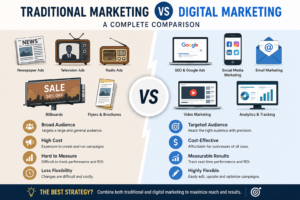
Traditional Marketing vs Digital Marketing is one of the most discussed topics in today’s business world. Marketing has always been the bridge between businesses and customers. Over the years, the way companies promote their products and services has changed dramatically. Earlier, businesses relied on newspapers, television, radio, billboards, and magazines to reach their audience. Today, digital platforms like Google, social media, email, and websites have become the primary channels for connecting with potential customers.
Both traditional marketing and digital marketing have their own strengths and limitations. Understanding Traditional Marketing vs Digital Marketing helps businesses choose the right strategy based on their goals, audience, and budget.
In this blog, we’ll explore Traditional Marketing vs Digital Marketing, their advantages, disadvantages, and help you decide which marketing strategy is best for your business.
What is Traditional Marketing?
Traditional marketing refers to offline methods of promoting products or services through physical and broadcast media. It has been the backbone of advertising for decades and is still widely used by many businesses. When comparing Traditional Marketing vs Digital Marketing, traditional marketing focuses on reaching customers through offline channels.
Common Types of Traditional Marketing
- Newspaper Advertisements
- Television Commercials
- Radio Advertising
- Magazine Ads
- Billboards & Hoardings
- Flyers & Brochures
- Direct Mail
- Event Sponsorships
Traditional marketing is especially effective for businesses targeting local audiences or customers who may not actively use digital platforms.
What is Digital Marketing?
Digital marketing is the promotion of products or services using the internet and digital technologies. It enables businesses to connect with customers across multiple online platforms while tracking campaign performance in real time. In the debate of Traditional Marketing vs Digital Marketing, digital marketing stands out for its flexibility and measurable results.
Popular Digital Marketing Channels
- Search Engine Optimization (SEO)
- Google Ads (PPC)
- Social Media Marketing
- Content Marketing
- Email Marketing
- Affiliate Marketing
- Influencer Marketing
- Video Marketing
- Mobile Marketing
Digital marketing allows businesses to reach the right audience with personalized messaging while measuring every click, impression, and conversion.
Traditional Marketing vs Digital Marketing: Key Differences
| Feature | Traditional Marketing | Digital Marketing |
|---|---|---|
| Medium | TV, Newspaper, Radio, Billboards | Websites, Google, Social Media, Email |
| Cost | Usually expensive | Budget-friendly and scalable |
| Audience Targeting | Broad audience | Highly targeted audience |
| Analytics | Difficult to measure | Real-time performance tracking |
| Customer Interaction | One-way communication | Two-way communication |
| Campaign Changes | Difficult after launch | Easy to edit anytime |
| Reach | Mostly local or regional | Global audience |
| ROI Tracking | Limited | Accurate and detailed |
The comparison of Traditional Marketing vs Digital Marketing clearly shows that digital marketing offers better targeting, analytics, and flexibility, while traditional marketing helps build strong local brand recognition.
Advantages of Traditional Marketing
Builds Brand Trust
Television commercials, newspapers, and magazines often create a strong sense of credibility among consumers.
Strong Local Presence
Businesses like restaurants, schools, hospitals, and retail stores can effectively target nearby customers.
Better for Older Audiences
Many people still rely on newspapers, radio, and television for information.
Long-lasting Visibility
Billboards and print advertisements remain visible for days or even months.
Limitations of Traditional Marketing
- High advertising costs
- Difficult to measure campaign success
- Limited audience targeting
- No direct customer engagement
- Campaign updates are expensive
- Lower flexibility
Advantages of Digital Marketing
Cost-Effective
Even small businesses can start marketing online with a limited budget.
Highly Targeted Campaigns
Businesses can target audiences based on:
- Age
- Gender
- Location
- Interests
- Shopping behavior
- Search intent
This improves conversion rates and reduces wasted advertising spend, making Traditional Marketing vs Digital Marketing an important comparison for businesses seeking higher ROI.
Real-Time Analytics
Digital marketing provides valuable insights such as:
- Website traffic
- Click-through Rate (CTR)
- Conversion Rate
- Bounce Rate
- Customer Demographics
- Return on Investment (ROI)
These metrics help marketers optimize campaigns quickly.
Global Reach
A business can reach customers anywhere in the world without opening physical stores.
Better Customer Engagement
Businesses can communicate directly with customers through:
- Comments
- Messages
- Reviews
- Emails
- Live Chat
- Social Media
This helps build long-term relationships and customer loyalty.
Limitations of Digital Marketing
Although digital marketing offers numerous benefits, it also has some challenges:
- High competition
- Constant algorithm updates
- Requires technical knowledge
- Results from SEO take time
- Privacy and data protection concerns
- Continuous optimization is necessary
Which Marketing Strategy is Better?
There isn’t a one-size-fits-all answer. The decision between Traditional Marketing vs Digital Marketing depends on your business goals, target audience, and budget.
Choose Traditional Marketing If:
- You want to build local brand awareness.
- Your target audience prefers offline media.
- You have a larger advertising budget.
- You are promoting events, retail stores, or community services.
Choose Digital Marketing If:
- You want measurable results.
- Your budget is limited.
- You need quick campaign optimization.
- You want to generate online leads or sales.
- You want to reach a national or global audience.
Can Businesses Use Both?
Absolutely. The most successful businesses combine Traditional Marketing vs Digital Marketing strategies to maximize their reach and improve customer engagement.
For example:
- A retail store advertises on local radio while running Google Ads.
- A real estate company uses billboards along with Facebook campaigns.
- A school distributes brochures and also promotes admissions through social media.
- A restaurant displays outdoor banners while encouraging online reviews and Instagram engagement.
This integrated approach helps businesses connect with customers across both offline and online touchpoints.
Future of Traditional Marketing vs Digital Marketing
As technology continues to evolve, digital marketing will play an even larger role in business growth. Artificial Intelligence (AI), voice search, personalized advertising, automation, and data-driven strategies are shaping the future of marketing.
However, traditional marketing will still remain valuable for branding, local outreach, and creating a lasting physical presence. Understanding Traditional Marketing vs Digital Marketing will help businesses build a balanced marketing strategy for long-term success.
Conclusion
The comparison of Traditional Marketing vs Digital Marketing shows that both approaches have unique advantages. Traditional marketing excels at building credibility and reaching local audiences, while digital marketing provides affordability, precise targeting, measurable performance, and global reach.
Instead of choosing one over the other, businesses should evaluate their objectives and create a balanced marketing strategy that leverages both channels. By understanding Traditional Marketing vs Digital Marketing and integrating offline and online efforts, companies can strengthen their brand, engage more customers, and drive sustainable growth in today’s competitive marketplace.